

Ceramic Rollers in Roller Kilns: Choosing and Caring for Them
How to choose ceramic rollers for tile and glass kilns, why rollers bend or break, and how to make them last longer.
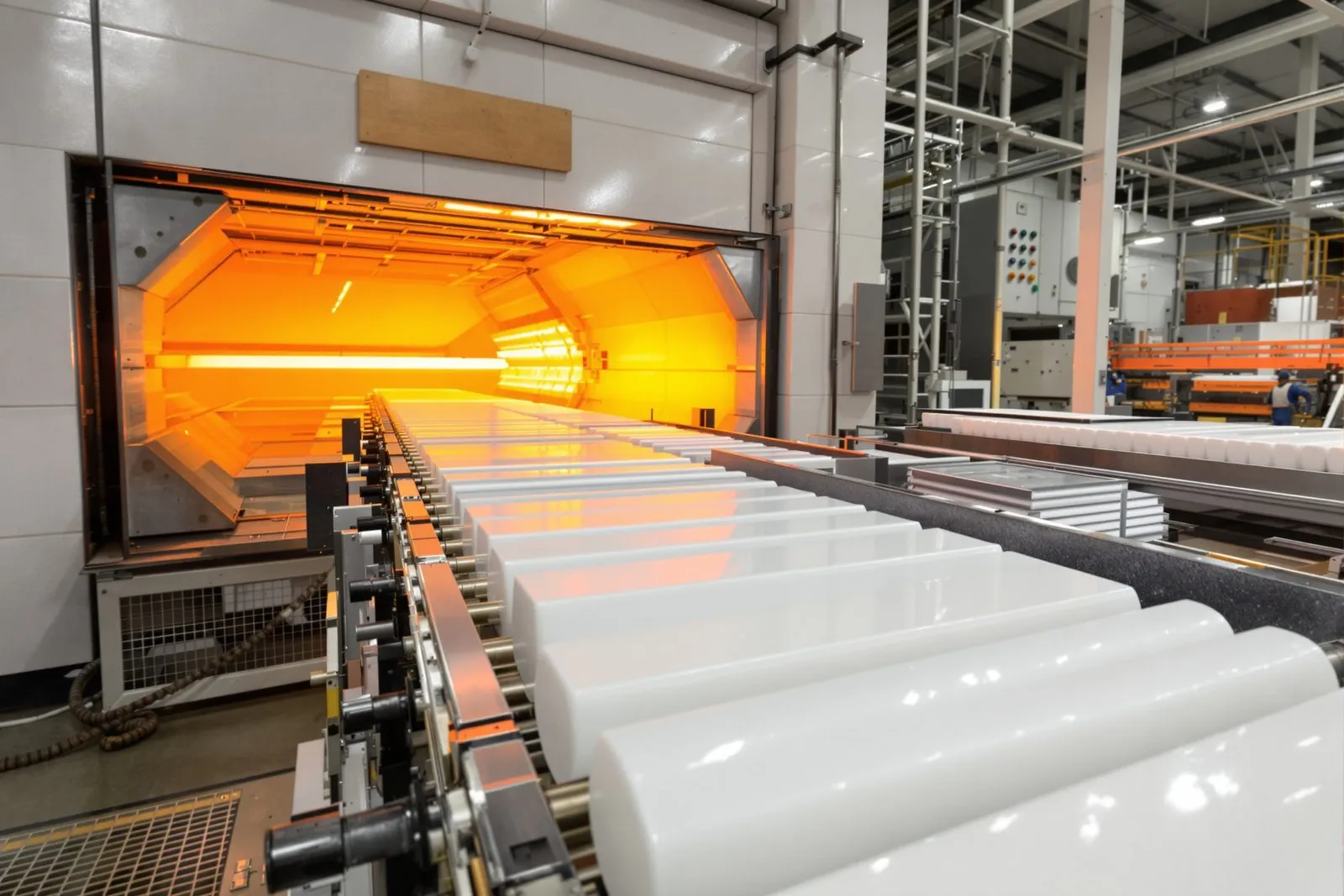
In a roller kiln, the product does not sit on a car or a belt. It rides on hundreds of ceramic rollers that turn slowly side by side and carry it through the hot zone. Roller kilns are used for ceramic tiles, sanitary ware, tableware and glass, because they are fast and fire evenly.
The rollers are small parts, but the kiln cannot run without them. A bent or broken roller can stop the line, scratch the product or cause a jam. Choosing and caring for them well saves time and money.
What a roller must do
- Stay straight at high temperature, under the weight of the product, for months.
- Handle thermal shock, especially near the entry and exit of the kiln and during stops.
- Resist glaze and dust, which can stick to the surface and build up.
- Turn smoothly, with a straight, round shape and the right length.
Choosing the right roller
By kiln zone
| Zone | Main need | Common choice |
|---|---|---|
| Preheating | Thermal shock | Alumina-mullite |
| Firing (hottest zone) | Strength when hot, no bending | High-alumina, or silicon carbide for very high loads |
| Cooling | Thermal shock | Alumina-mullite |
| Glass tempering | Very low expansion, clean surface | Fused silica |
By size
The diameter and wall thickness must carry the load across the kiln width without bending. Wider kilns and heavier products need thicker, stronger rollers. The length and end shape (plain, grooved or drilled) must match the kiln’s drive system.
Why rollers fail
- Bending (creep). At high temperature, a roller under load can slowly sag. This happens faster if the roller stops turning while hot, or if the load is too heavy for its size.
- Breaking from thermal shock. Sudden cold air (an open door, a cold product, a stop) can crack a hot roller.
- Build-up on the surface. Glaze and dust stick to the roller, make it uneven and mark the product.
- Rough handling. Knocks during storage, fitting or cleaning cause small cracks that grow later.
Simple ways to make rollers last longer
- Keep them turning. Never let rollers stand still in a hot kiln. If the drive stops, restart it or move rollers by hand as soon as possible.
- Change rollers carefully. Preheat new rollers before putting them into a hot kiln, and push them in slowly.
- Clean them regularly. Remove build-up with the right cleaning method for the roller type. Some kilns use a protective coating on the roller surface to reduce sticking.
- Rotate positions. Moving rollers between zones or turning them can spread wear more evenly.
- Store them well. Keep rollers flat and supported along their length, dry and away from knocks.
- Keep records. Note when each roller was fitted and why it was removed. Patterns show you where the real problem is.
When to change supplier or type
If rollers in one zone keep bending or breaking, the cause may be the material or the size, not just the way they are used. A small change, like a thicker wall or a different material for that zone, can make a big difference.
How we can help
Send us the roller size (outside diameter, wall thickness, length), the end type, the kiln zone and temperature, and the product. A photo of a failed roller helps us find the cause. See our ceramic rollers or contact us.
Related Articles
Technical Ceramics in Industry: A Practical Guide
Alumina, zirconia, silicon carbide and more: what technical ceramics are, how they differ, and where each one works best.
Ceramic Foam Filters in Metal Casting: A Simple Guide
How ceramic foam filters clean molten metal, how to pick the material and pore size, and where to put them in the mould.