

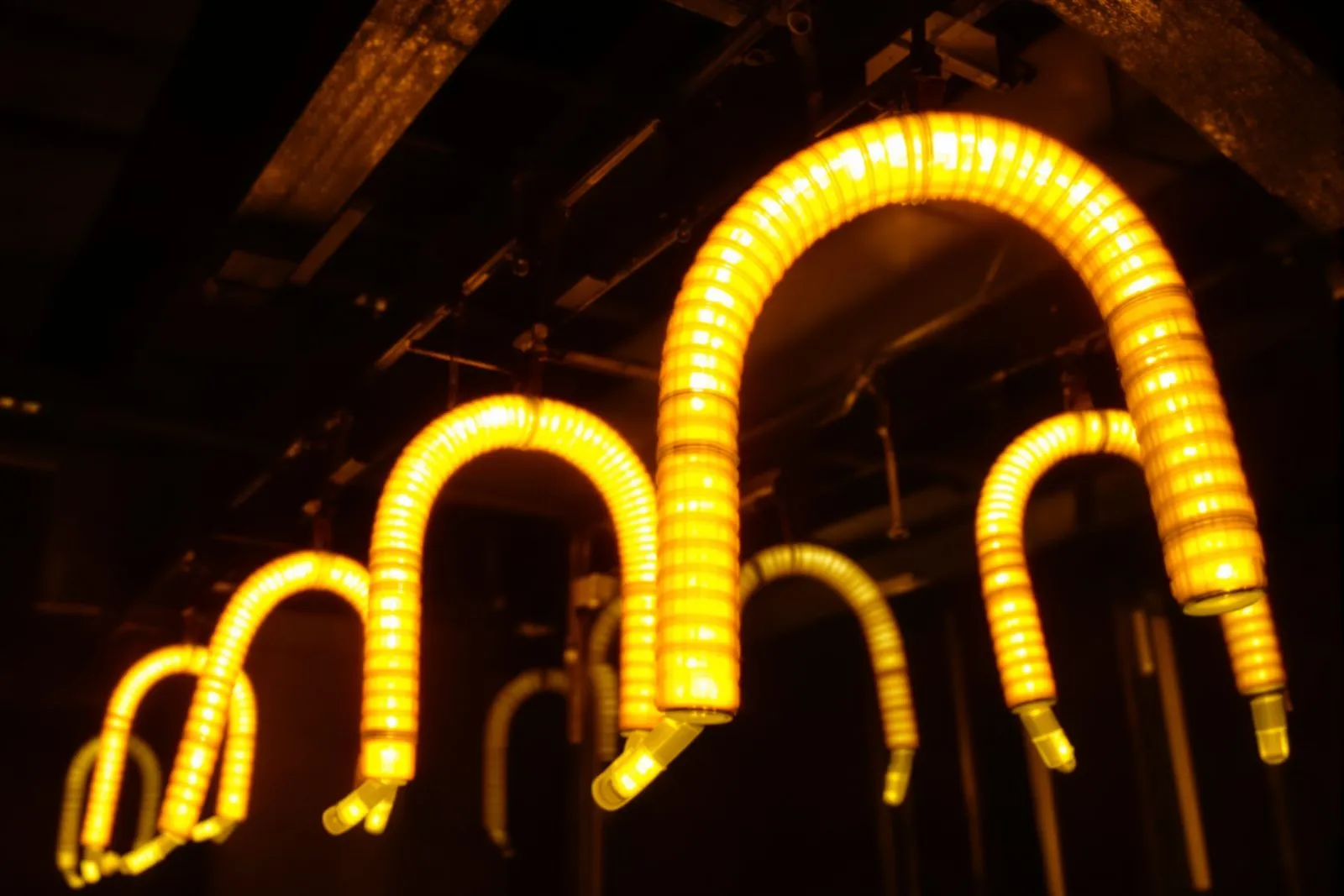
MoSi2 Heating Elements: How They Work and Where to Use Them
How molybdenum disilicide elements reach very high temperatures in air, what they are good at, and what to watch out for.
If your electric furnace needs to run above about 1,500 °C in air, there are not many heating elements that can do the job. The most common one is the molybdenum disilicide (MoSi2) element, often just called a “molybdenum element”. This article explains how it works, where it fits, and what to watch for.
How a MoSi2 element survives such heat
Most metals burn (oxidise) quickly when they are very hot in air. MoSi2 does something clever: when it heats up, the silicon in it reacts with oxygen and forms a thin layer of silica glass on the surface. This glassy skin protects the material underneath. If the skin cracks, it heals itself the next time the element is hot.
Thanks to this layer, MoSi2 elements can work at element temperatures up to about 1,700–1,800 °C in air, depending on the grade.
Strong points
- Very high temperature in air. Higher than silicon carbide and far higher than metal wire elements.
- Stable resistance. The resistance hardly changes with age, so a new element can be fitted next to old ones without trouble.
- Fast heating. High power can be used, so furnaces reach temperature quickly.
- Long life when used correctly, even with continuous operation.
Weak points
- Brittle when cold. The elements must be handled and fitted with care. When hot, they become slightly soft, so they usually hang down vertically.
- “Pest” in the middle range. Held for a long time at about 400–700 °C, the material can slowly crumble. Furnaces should pass through this range quickly.
- Some atmospheres are a problem. In hydrogen, vacuum or some other gases, the protective glass layer cannot form properly, so the maximum temperature is lower. Ask before using MoSi2 in a special atmosphere.
- Low cold resistance. The power supply must be designed for it, usually with a transformer and thyristor control.
Typical uses
- Laboratory and research furnaces up to about 1,700 °C
- Sintering of alumina, zirconia and other technical ceramics
- Glass melting, glass fibre and glass research
- Heat treatment, crystal growth and electronics
MoSi2 or silicon carbide?
Both are ceramic elements, but they suit different jobs. Silicon carbide is strong and works well up to about 1,450–1,500 °C furnace temperature, and it usually costs less. Above that, or where you need very fast heating, MoSi2 is the better choice. We compare them side by side in Silicon carbide or MoSi2.
What to tell us when you order
| Detail | Why it matters |
|---|---|
| Shape (U, W, bent, other) | Must fit the furnace layout |
| Heating-zone length | Sets how much heat the element gives |
| Terminal (cold-end) length | Must pass through the furnace wall |
| Diameters of heating and terminal parts | Set the current and the holder size |
| Distance between the legs | Must match the holes in the roof or wall |
| Highest furnace temperature | Sets the grade of the element |
If you have an old element, a photo with a ruler next to it is a great start. See our molybdenum elements page, or contact us with your details.
Related Articles
Silicon Carbide or MoSi2: Choosing the Right Heating Element
A plain comparison of the two main ceramic heating elements: temperature, life, cost and what your power supply needs.
How to Make Furnace Heating Elements Last Longer
Simple checks and habits that help silicon carbide and MoSi2 heating elements last longer and fail less often.